Showing posts with label Statistics and measures. Show all posts

Saturday, April 29, 2017

Hotel Management: What is a healthy ratio of food & beverage revenue to room revenue?

Zero to irrelevant. (I'm not being a wise guy. I'm serious.)
  • If you have a limited service or select service operation with a breakfast, manager's reception, or snacks and sodas provided to attendees of your events in whatever meeting or small conference space you have; then you have no f&b revenue or, if you do (say, the eight to ten bucks you can be asked to pay for a cooked-to-order breakfast at a Hilton Garden Inn), food is only incidental to your main business of renting the rooms, or renting the conference facility. The $8-10 you charge for breakfast at a Hyatt Place (another one of those new, 'upscale select service' brands that, along with Hilton Garden Inn, are a growing segment of the business . . .) will take the edge off the cost of providing it, but will not amount to a significant revenue source by comparison to your room charges - if it even completely covers the cost of providing the food.
Image result for hotel restaurant

Hotel Management: What's a good multiple to use for ADR when trying to figure out the average daily rate for a 2, 3 or 4 bedroom suite?

For an entire hotel, average daily rate - ADR - is ADR (your total room revenue for the night divided by the number of rooms you rented that night, period, regardless of room type or room inventory). You can't really pro-rate it for two or three-room suites, because you can't rent just one room in a suite and leave the other unoccupied, or rent it to someone else. ("ADKey" is a term so not in use to describe a hotel statistic, that you can't even get any relevant hits if you Google it, which I attempted before I answered your question; but I guess you could refer to it as ADKey if you want, since that's about the size of it.)

Image result for hotel suite

ADR works better as a statistic if it is applied to similar room types; the more similar, the better. I could see applying ADR to an entire hotel with a mix of rooms and suites then, in addition, calculating ADR for standard rooms (and within that, ADR for doubles, ADR for kings, etc.), as well as ADR for suites (then within that, ADR for 'shotgun' suites like you'd find in a Comfort Suites or the older Embassy Suites, ADR for studio suites, ADR for one-bedroom suites, ADR for two-bedroom suites, etc.); as useful information.

Saturday, February 4, 2017

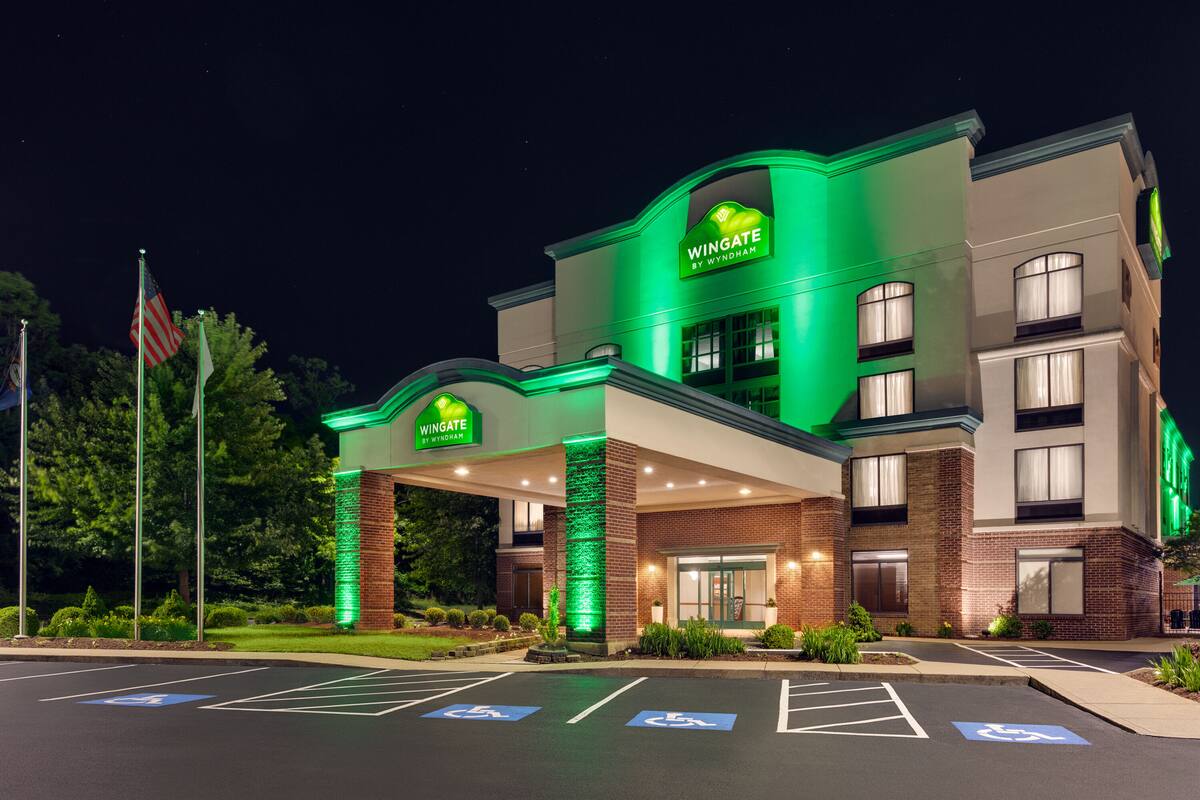
Hotel for sale: Wingate by Wyndham Louisville East

Image result for wingate by wyndham louisville east


Property offering

Listing broker: MBA Hotel Brokers.  (This is a "pig in a poke" listing that does not identify the specific property, and I don't like those. It's more annoyance than harm: merely downloading a property photo, then running it through Google Image Search, identifies the particular property for you about half the time. But I still appreciate transparency, and straight answers. If I buy, it'll be because I made the choice to buy; it won't be because you sold it to me.)

TripAdvisor reviews: Bubble score 4.0.


Property website:

Wingate by Wyndham Louisville East (Wingate by Wyndham child site)


Asking price$6,800,000Given
Number of rooms74Given
Annual gross$1,700,000.00Given
Occupancy83%Estimated*
ADR$75.65Estimated*
REVPAR$62.94Calculated
Room revenue multiplier4Calculated
Year built2006Given

* - TripAdvisor shows lowest publicly available rates for this property between $84.00 (current) and $94.00 (June, 2017); which we averaged out to an average rack rate of $89.00. ADR is based on 85% of rack, which you usually see in a property listed for sale unless some unique marketing or pricing scheme is in place that you don't know about.

In a property that has no restaurant or lounge or some other source of significant revenue, nearly all revenue is from rooms, so REVPAR (in this case, calculated by simply dividing the annual revenue given by the number of rooms, divided again by 365) becomes pretty meaningless, However, it does come in handy for one thing: in a limited service property when an occupancy figure is withheld, you can calculate it by simply dividing REVPAR by ADR.

The facility:

This is a newer, Wingate prototype facility, constructed in 2006.

Thursday, February 2, 2017

First jobs, and inauspicious (however fortunately inconspicuous) beginnings . . .

Inspired by an article by Larry Mogelonsky at HOTELSMag.com
(Screenshot appears at bottom...)
------------------------------------
My own first job in a hotel was working for a group of drug traffickers, who were using a pair of Durham, N. C. hotels as a money laundering operation.
I am not making this up.
After I left that job, I was actually questioned by North Carolina Alcohol Law Enforcement (NCDPS - Alcohol Law Enforcement ) about their activities, told the ALE guys everything I knew (which amounted to . . . nothing at all other than that my former employers were people of highly questionable character, reputation, and wisdom - although by then, I wouldn't have put it past them at all to be involved in something like that, which was a big part of why I'd moved on to another job . . .). I then shared what I found out from the ALE guys with my former g.m. (we were still friends, and I was confident she wouldn't be involved in anything illegal); and while at first she didn't believe a word of it (she knew I didn't think too much of the company's 'owners'), I later learned from her, right after she resigned abruptly from that company, that I 'was right about them all along'.

Image result for imperial 400 motor inn durham
The 400 in its younger days, as Durham's original Holiday Inn.
And I had been fixed up with that job by a Durham city councilman.


How do you get into hotel management?

Start as a night auditor; preferably in the largest full-service hotel, with the most food-and-beverage, meeting and banquet, lounge and gift shop operations on premises, that you can get to hire you.

It's actually a pretty easy job to get as far as hotel front-office jobs go - the hours are crap. It runs in most properties at 11 at night to 7 in the morning, (and no, it can't be done in the daytime), which is why the demand exceeds supply when the economy is good and jobs are plentiful, and why supply doesn't exceed demand by much when jobs are scarce and you see more people competing for any job they can get (including hotel night audit jobs with crappy hours). You don't want to be there forever, but as you yourself pointed out, you're there to learn.


That's where you learn how the numbers go together and what affects them, essential know-how for the management of any business.

Pay attention to what you're doing in that job. Back in the day, experience was a plus, but if you brought along sufficient accounting skills to balance your checkbook the old fashioned way (using the form printed on the back of your bank statement, making the entries and doing the math; rather than just checking your balance online), you could be trained - balancing accounts, after all, is most of what the job of night audit is about. (Most business get audited by their accountants every quarter. Hotels are unique in that they get audited every night.)  Nowadays, nearly all hotels have computerized front desk management systems; so to too many hire-for-personality-and-train-for-ability hotel 'administrators' and the people they insist on hiring, the job consists mostly of going down a list of reports to be printed, and printing out, and collating and routing, several stacks of reports. If it wasn't for the fact that it's necessary to do a bucket check and confirm the rates of all your guests, and make sure your cash and credit card totals balance (as well as your restaurant and banquet checks if it's a full-service hotel), a trained monkey or service animal could do it. 

How many staff is needed for a 60 room hotel?

You need as many as you need. It's not a Navy ship: you don't have a "compliment" (I'm not a believer in organizational charts), but you've got a lot of work to do, and you need a number of people there who can get it all done.

Image result for hotel staff meeting
Some people try to run a hotel without a 24-hour front desk, but with over 30 rooms (and anything smaller is a bed-and-breakfast, or a Mom and Pop), I wouldn't try anything like that. So the front desk has to be attended 24–7 -- 168 hours per week. Four full-time equivalent employees could get it done, with one odd shift left over for the general manager to take a turn at driving the desk each week (which is a practice I'd encourage anyway, especially in a property that small).
You're probably going to need more than four people. Between the inevitable scheduling issues, people calling off, occasional turnover, and some people who just don't want to work more than four days a week; if you try to get by with just four bodies, you're going to be vulnerable to incurring overtime pay. But on the front desk, you're still going to have the equivalent of four people working 40 hours a week, plus the extra eight hour shift.


Thursday, January 26, 2017

What is the one feature, outside basic necessities like running water, that every hotel room should have?

A bed, some clean bedding, four walls, a floor, a roof, a clean bath, and a locking door. 

And then, the question becomes, do you want to be able to rent the darn thing to human beings that you wouldn't mind having as guests? Because that's what it comes down to: each person measures their own 'need'. Define essential. Whatever item you name, you might feel very uncomfortable without it, even though not that many people feel the need for it. Or you could do without it just fine, but the guy next door will suffer through his stay for lack of it. (Do you actually watch all the channels you have on your cable TV? Yet, even if one of the 'amazing TV offers' channels were eliminated, someone would complain to the cable company.)

Image result for sleep cheap

We once tried to come up with a hotel with bare-bones amenities, where we could rent the rooms cheap cheap. (Twitter was a new thing, then, and people seemed to like the little blue bird, so inspired by that, and the 'cheap cheap' description, we even came up with a brand for it: 'Bluebird Hotel'.) 

I mean, we were downright shameless and aggressive about it, looking for every way in the book plus a few no book would dare print, to cut costs and make it possible to rent the rooms for forty bucks a night or under.

Wednesday, January 25, 2017

What is RevPAR in the hotel industry?

REVPAR = "revenue per available room".
It can be applied to economy or mid-market hotels, where room revenue is nearly all of your total revenue, but doesn't tell you a whole lot other than that you're not doing a very good job of filling your rooms, if it's much lower than your average daily rate (ADR) -- as though the occupancy percentage isn't the giveaway on that.
Image result for hotel cost control
It becomes a more useful figure when room revenue is only part of your total revenue; because your total revenue will include food and beverage -- restaurant and lounge -- meeting and banquet space, and any resort fees (real resort fees, from things guests actually use and know ahead of time they're going to be asked to pay for, like maybe a golf course), a casino (if you were so fortunate to have one forty years ago, when they were the thing to have; as opposed to now, when they're anything but); and income from retail operations on property and any extra-cost services (laundry and valet, phone, wi-fi if you charge for it).
Even then, unless you're also looking at CPAR (cost per available room) and GOPPAR (gross operating profit per available room), as Mike Holovacs pointed out, you're only seeing part of the story -- for both the entire hotel; and for each department and revenue stream, and costly service or amenity offered, within it.