Showing posts with label Sales. Show all posts

Saturday, April 29, 2017

What tool can businesses use to negotiate rates for their company at hotels?

Both Priceline and Hotwire have opaque booking capability, if all you're looking to do is book a cheap room from time to time. In order to get the cheap-cheap rates they occasionally have available, you have to take the room they give you, at the hotel they give you. Opaque is what Hotwire is all about, and Priceline still has its 'name your price' feature that's a standby for bad inventory planning on the part of the hotel, or for new hotels trying to assemble a critical mass of customers in a hurry.

Image result for hotel rate negotiation

When negotiating a corporate or group account with one or more hotels for your company, you need to be thinking 'high-touch', not 'high-tech'. I'm not aware of any software that will do it for you. It's a service, not a product. There's skill and even a little human instinct involved: it can't be reduced to an algorithm that can be processed by a computer.

Thursday, February 16, 2017

What does it take to start a hotel?

Money. Of course.
Unfortunately, way too many hotels are 'started' by people who are completely unmindful of the fact that they could need anything more than that. Even more unfortunately, the ending is frequently a disappointing, if not unhappy, one in such cases.
Image result for hotel construction
You posted this question - whoever you are - anonymously, so I'm going to make certain (hopefully accurate) assumptions about you, in an attempt (hopefully appropriate) to make it a little easier for me to answer your question intelligently.
  • You are looking to 'start' your hotel in the USA.
  • You have capital, or access to adequate (although not unlimited) capital, and financing won't be a problem.
  • You have limited, if any, hotel experience.
  • You're sensible when it comes to business, you're not expecting to get rich quickly, you're in it for the long haul, and your expectations about life are generally realistic.
  • You're a respectable, decent person who desires to be part of a respectable venture in which you can take pride; not someone who's in it for the fast buck, who just wants to launch it next year, hoping to sell it off the following year for a quickie profit, and/or who'd just be trying to milk the last five dollars out of a $3.98 investment for however long it took to find some sucker to buy it.
  • Since you're asking, how does one 'start' . . . you're probably contemplating new construction, not acquiring an existing hotel. (I have a suggestion. Please consider it carefully. If it's your first time, and you have no construction or real estate development experience, consider the acquisition route, at least starting out. New construction requires somewhat more of an investment, it'll take awhile before you get a payout [where, with an existing property, you're getting at least some cash flow the first night after you take possession], and there is more risk involved [e.g., unforeseen cost overruns]. You can always do new hotels later as you gain experience and confidence - as well as revenue streams from your existing properties.)
  • Accordingly, I'm going to assume that you're someone I should advise conservatively.
If my answer doesn't come even close to what you need, it'll be because a dialogue would be more appropriate and we need to have a talk. Please feel welcome to contact me.

Thursday, February 2, 2017

How do you get into hotel management?

Start as a night auditor; preferably in the largest full-service hotel, with the most food-and-beverage, meeting and banquet, lounge and gift shop operations on premises, that you can get to hire you.

It's actually a pretty easy job to get as far as hotel front-office jobs go - the hours are crap. It runs in most properties at 11 at night to 7 in the morning, (and no, it can't be done in the daytime), which is why the demand exceeds supply when the economy is good and jobs are plentiful, and why supply doesn't exceed demand by much when jobs are scarce and you see more people competing for any job they can get (including hotel night audit jobs with crappy hours). You don't want to be there forever, but as you yourself pointed out, you're there to learn.


That's where you learn how the numbers go together and what affects them, essential know-how for the management of any business.

Pay attention to what you're doing in that job. Back in the day, experience was a plus, but if you brought along sufficient accounting skills to balance your checkbook the old fashioned way (using the form printed on the back of your bank statement, making the entries and doing the math; rather than just checking your balance online), you could be trained - balancing accounts, after all, is most of what the job of night audit is about. (Most business get audited by their accountants every quarter. Hotels are unique in that they get audited every night.)  Nowadays, nearly all hotels have computerized front desk management systems; so to too many hire-for-personality-and-train-for-ability hotel 'administrators' and the people they insist on hiring, the job consists mostly of going down a list of reports to be printed, and printing out, and collating and routing, several stacks of reports. If it wasn't for the fact that it's necessary to do a bucket check and confirm the rates of all your guests, and make sure your cash and credit card totals balance (as well as your restaurant and banquet checks if it's a full-service hotel), a trained monkey or service animal could do it. 

Wednesday, February 1, 2017

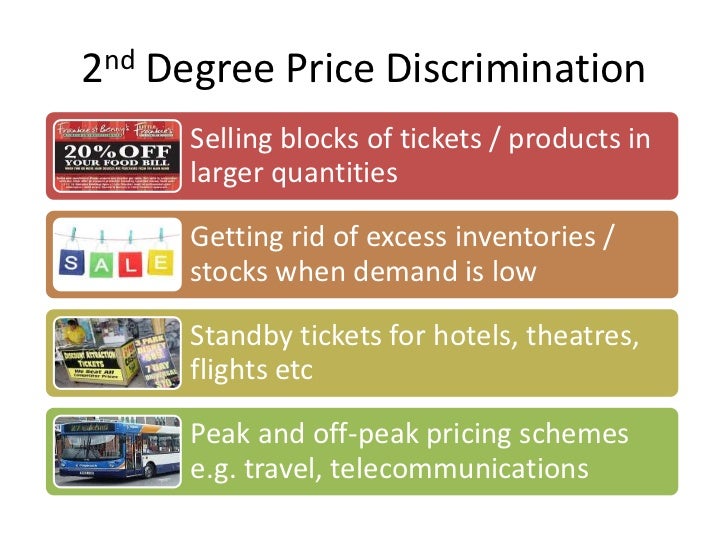
Is price discrimination good or bad?

Price discrimination is neither good nor bad. Price discrimination, when it occurs, is part of the price: you either pay the price asked of you, negotiate something more favorable if you can, or seek something more favorable elsewhere.
Image result for price discrimination

Hotels are a business that, to someone who sees price discrimination as a bad thing, would be among the most persistent offenders; so let's use those as an example.

Hotels: How do people choose a hotel?

It's very much an individual decision. There are as many possible answers to this question as there are hotel guests. 

Actually there are more possible answers than there are individuals. Every individual has his priorities, but for each person, one or more secondary factors will be taken into account as well -- many of which will still be significant enough to make a difference in whether or not he wants the room at a particular hotel at all, and any of the others sufficient to prompt him to choose one hotel over another.


If I knew them all, I could retire comfortably in just a few years. (And if I knew, out of fifty-odd numbers, which six will win next week's Powerball jackpot, I could retire even more quickly.)  But I can't. I'm not a mind reader.  Besides, there's seven billion people on the planet, times . . . how many features, and services, and amenities are on your list of 'must have' items when you check into a hotel (as you'll see, they don't have to be big things . . .), times . . . how many possible combinations after you take into account all the other possible things in or about a hotel that you could care less about?  Do the math. It's a big number.

Several factors do turn up over and again, however:


Wednesday, January 25, 2017

What is the best hotel strategy to increase occupancy and revenue? How can we differentiate ourselves to compete with other big hotel competitors?

No single 'expert' has an answer to this one that will work for everyone, and any answer I give you will be questioned (along with my 'expertise', and 'qualification' to answer the question), by someone, somewhere. So -- as with any question that calls for me to give you expert advice, I can tell you how I'd go about it, with most any hotel. Parts of it won't work for every hotel. Nor will I pretend to you that I have all the answers.
Image result for hotel sales and marketing
(I'm assuming here that you have a marketable hotel that does not have a franchise -- or that, if you do have a franchise, you are smart enough to know that your franchise organization does not have all the answers either, which puts you ahead of 95% of the people in this business.)
Here is how I'd go about it:

Sales: What are some best responses to "Sell me this hotel room"?

"I see you have no idea whatsoever how to successfully market a hotel, or how to find or identify candidates who might, nor would you know how to work with and properly supervise someone who could perhaps help you in that area; so I won't waste any more of your time. Good day."
Image result for marketing sales superfluous
Hotel sales and marketing people do not sell hotel rooms, they market the hotel. You might point out a unique design or uncommon amenity item in the rooms; but as far as 'selling a hotel room' goes, there is very little differentiation between hotel rooms found within the same class of hotels, even between competing hotels, unless you're selling a recently renovated Class B or economy property.

If a hotel management company is compensated based on sales, wouldn't it be incentivized to increase sales instead of profitability?

It is, and it frequently happens.
Hotel management companies charge a base fee of two to five percent of revenue. And many charge an incentive fee of fifteen percent of any increase in revenue over that of the prior year. The base fee is assured. The incentive fee may or may not amount to much, if there's an improvement in revenue over last year at all. (There are also upgrade fees, and those offer their own opportunities for abuse, but we're not dealing with those as part of this question.) 
So, if I want to ramp up my fees, the fast-and-easy way to do it (if not the best way for the client-owner) is to get as much money coming in the door, as soon as possible, without a lot of thought to how much your costs are eating up almost all of it as fast as it comes in. Offering low rates to certain people just to fill the rooms? Do it. Renting to rowdy local people? Do it. Bringing business into the hotel that costs us as much as they pay us? Do it.
But if our agreement is tied to profitability, such an agreement would have hazards of its own. It would incentivize a lot of bickering between us and the client-owner about what should count as profit and what shouldn't, and how we could have made more profit if we'd done this, or hadn't done that. It would disincentivize reinvestment, or even good maintenance. It would incentivize shortcuts that would have consequences that would come up later. It would incentivize the taking of risks that might have bigger consequences that would sooner or later show up. It would incentivize doing things on the cheap. Your property would lose value over time and sooner or later have bigger problems.