Showing posts with label Customer-facing. Show all posts

Saturday, October 28, 2017

I've heard that hotel staff deliberately disable the keycards of guests they dislike. Can anyone confirm this, or tell of other things hospitality staff do to get back at badly behaved patrons?

Just a little thought at all should tell you that this story is not credible.

If I took a dislike to a guest, the last thing I would want to do is disable his key card, unless there was some business or security related reason I had to, because you know exactly what's going to happen: the guy's not going to be able to get into his room, and he's going to be at the desk, in your face, complaining, and you've got to put up with him, for at least long enough to fix his card.


The same goes for any other juvenile pranks that you might want to do to a guest to get paybacks or make his life miserable. Never mind the guest is unhappy (which is always a very large concern with us), but any employee who enjoys the kind of confrontation that would result from something like that is too sick to have a job.Even if you feel that it's justified in some way, it just doesn't work.

And that's before we even go there about the consequences if the guest complaints to management . . . or even worse, to the franchise organization (who will often comp the room and give him a full refund and a bunch of free coupons to make him feel better about the whole thing, just for showing up and complaining, then bill it all back to your hotel, and you're going to have a very unhappy general manager) . . or the health department.

Wednesday, May 24, 2017

This isn't just a Starbucks disease

Many hotels are bad about it, too.

Business Insider article: Starbucks is quietly changing the business as furious baristas slam the 'cult that pays $9 per hour'

starbucks barista


Observations:

We've seen this before: Management wants to micromanage the customer experience and leans too heavily upon 'service' and connection (which you can't force). Some even attempt to use it to cover inadequacies in the operation or facility itself. It makes any employee exposed to culpability for anything, and makes for a very unhealthy work environment.

No matter what the 'benefits' are, their value will show up as nebulous if you're not paying a living wage.


Tuesday, April 18, 2017

What are some good questions to ask a customer service candidate in an interview?

Define 'service'.

(This assumes you use your interview process to not only acquaint your applicant with your company culture, and what the expectations are like, etc., but to actually get to know him or her in a meaningful way, as well . . .)

You do encounter a lot of people in this business who like to see that Wind-up Barbie Doll 'Service Personality' With The Beaming Pan-Am Smile - and accordingly, you do have applicants show up with the notion that that's what'll be expected of them and that's what they should try to project. (It only shows that applicants and experienced managers alike have a pretty screwed up idea of what 'service' is all about.)

Image result for customer service

Let's start by defining what service is not. Service is not self-demeaning. It's not self-deprecating. It's not sycophancy. It's not inauthentic. It's not dressing up your staff in an organ grinder's monkey vest or a fake, cheap tux. It's not using scripted customer greeting: you don't 'make the guest feel welcome' by manipulating the guest.

Monday, April 17, 2017

How far should hotels go to please and appease dissatisfied or unhappy guests?

I've seen very well-run hotels - ranging from economy to full service - draw a high number of guest complaints. I've seen some very sloppily run hotels - properties with obvious housekeeping, maintenance, or service problems - that drew almost none at all. Some of my colleagues have also noticed the phenomenon, so we sat down one time, asked why, and actually drew a graph. (X axis=frequency and occurrence of guest complaints on a scale of 1 to 10, Y axis=condition of property and quality of staff, service, etc. - 'is this a good hotel?' - on a scale of 1 to 10) and included every property in which any of us had ever worked.

What set the 'high-guest-complaint' hotels apart from where the guests were more content? Managers and staff buy into the complaints when they occur. Yes, you want to keep the guests happy; yes, you don't argue with an unhappy guest and yes, of course, you want to be sensitive to their needs and fix the problem. But the flipside of that is, you don't swing the other way. You don't get emotionally invested in the guest or the complaint, you don't over-respond... effectively, you don't "reward" the guest for having a complaint. You apologize, fix the complaint - and stop when the problem's been solved and the guest is happy and willing to come back, and leave it at that. Added 'delight' on the part of the guest following a problem or complaint gives you a nice, warm, fuzzy feeling inside, but over time it works against you.

Image result for guest complaint


(Yes, I want the guest to be 'delighted' too, to experience a higher level of satisfaction than he or she expected. But I want it to happen in response to what we do well, 99.5% of the time, not as a result of a one-out-of-two-hundred complaint. Doing good is the norm for what we do. Problems are the exception.)

Thursday, February 2, 2017

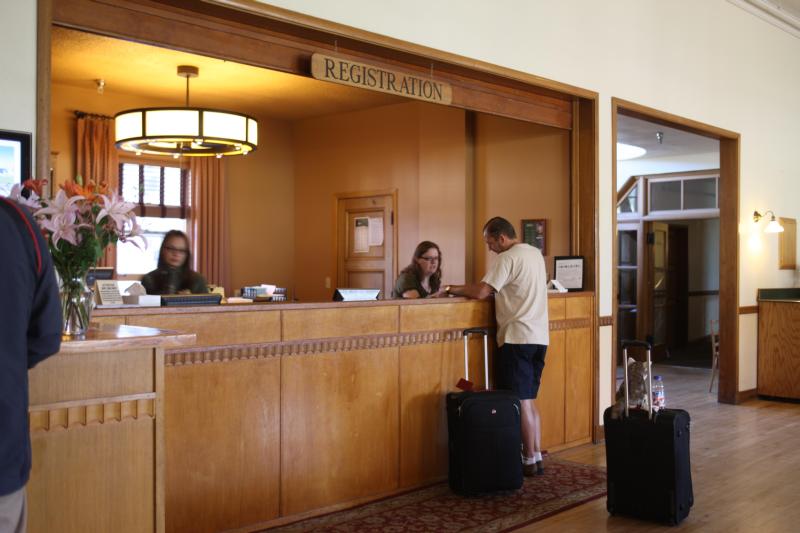
What is the actual average length of time (in minutes) for hotel check-in and check-out?

It depends on the hotel and the amount of paperwork involved. 

Image result for hotel registration
 
Assuming minimal interaction with the guest, no problems with room availability or the reservation at check-in, and no problems with a bill or guest complaint at check-out; I'd say that 2-3 minutes for a check-in, about half that much for a check-out, is doable.
 
This is what I could shoot for at a well-run Choice or Best Western property.

Originally appeared on Quora

Wednesday, January 25, 2017

Arriving early to a hotel, I often hear "your room is not ready yet." Do hotels reserve you a particular room or do patrons simply have a spot in the hotel reserved for them?

We have a certain number of spots - rooms - reserved for a certain number of guests, and one of them is you.

As for the bad news, "your room is not ready yet" . . . Is it your own darn fault?  You'd be amazed at how frequently it could be!

Image result for hotel reservation

We tell people (or we're supposed to tell them, although rushed desk clerks taking reservations, or reservations agents, frequently forget to mention it, or people don't read it on the webpage when making their reservation...), check in time is at 3:00.  

What time do people begin arriving?  That's right -- whenever they show up . . . wanting to be checked in to their room right away . . . 

But the housekeepers need that much time to clean the rooms from the night before.  (This is also the root of the flipside of the same problem - people overstaying checkout: Michael Forrest Jones' answer to How lenient are hotels when it comes to checking out late? )

If I work the front desk at a hotel and someone has been told not to trespass, can I remove them with reasonable force? (This is in Oklahoma, by the way.).

Legally, you probably can, but it's not a good idea. I'd call the cops and let them handle it. It's a nuisance call, but many cops would rather handle it than respond to a larger disturbance, clean up after a fight, or bring an ambulance along for an injury.

Image result for no trespassing signs funny

If you use force at all (or even put your hands on the trespasser) you risk provoking an altercation, or give him the 'ammo' he needs for an accusation against you of assault.  The police can get it done much of the time without using force, and any force they do use will not nearly as likely be second-guessed.

Originally appeared on Quora

Is there a way out of endless hospitality/customer-facing circle?

Is having to deal with customers something that’s not working for you, or do you just want a 9-to-5 job in a supporting accountability? It makes a difference.
Image result for customer service training
There’s no way to get away from dealing with guests if you work in a hotel. And you won’t get completely away from it as a business travel consultant, and certainly not as a reservationist. (I’m a bit of an introvert and let’s face it, that’s not always my favorite part of it. It doesn’t come naturally to me, I have to work at it. But it’s something I have to be able to do well at a certain level . . .)