Wednesday, February 1, 2017

Is price discrimination good or bad?

Price discrimination is neither good nor bad. Price discrimination, when it occurs, is part of the price: you either pay the price asked of you, negotiate something more favorable if you can, or seek something more favorable elsewhere.
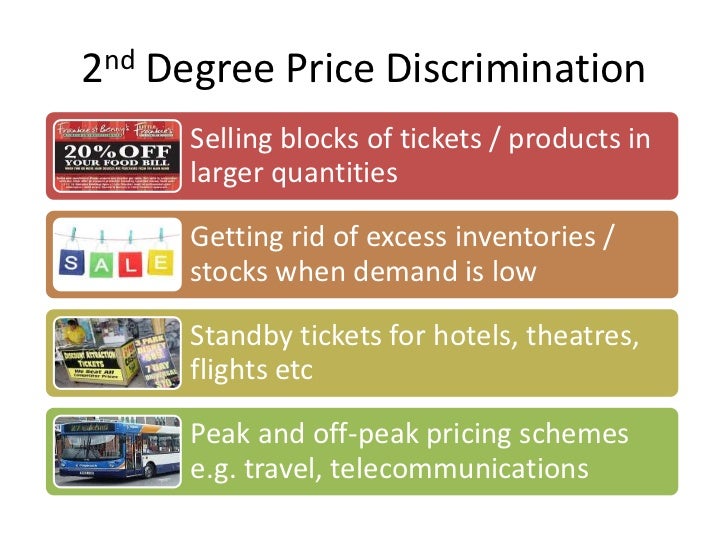
Image result for price discrimination

Hotels are a business that, to someone who sees price discrimination as a bad thing, would be among the most persistent offenders; so let's use those as an example.

Why don't hotel rooms have liquid soap dispensers?

Like this?


It's too high-tech for a hotel. Seriously. 

And it's unsanitary. 

(Are you already starting to not believe a word of this one? . . .)

This past week I've been letting daylight in upon magic and holding us up for ridicule as an industry disinclined to have our technology keep up with the times and modern needs (Michael Forrest Jones' answer to Why does it take so long to check in at hotels? ), but oddly enough, this really is too high tech for a hotel. Before you start laughing . . . well, here's why: 


How bad are these hotel housekeeping lapses?

How bad, as in 'how dangerous', or 'how extremely gross'?  Not very. Usually, when they occur, they're pretty obvious, like the ones you mentioned. Usually, someone, often a guest, will spot something with the potential for extreme grossness before it gets too gross. Even the less obvious ones - dust across the top of a picture frames, film in the tub, grunge around the base of the toilet, something under a bed (beds should be on box bases, not angle-iron frames; but in some hotels, some still aren't) - are pretty obvious if someone just looks.

Image result for anthony melchiorri housekeeper

As far as dangerous or extremely gross goes, the worst I've seen - at separate incidents, in separate hotels of varying quality - were sharp objects left laying around: once the blade of a carpet knife left in the floor of a room where the carpetlayers weren't doing a very good job of picking up behind themselves (the hotel was being remodeled on the fly) resulting in injury to a guest; another time a hypodermic syringe left in the drawer of a nightstand (fortunately no injury beyond a disgusted guest who demanded a refund right away, although I'm aware of a situation that did occur at a Motel 6 in Virginia Beach where a small child had an unpleasant encounter with a previous guest's syringe while crawling around in the floor, and had to be hospitalized).


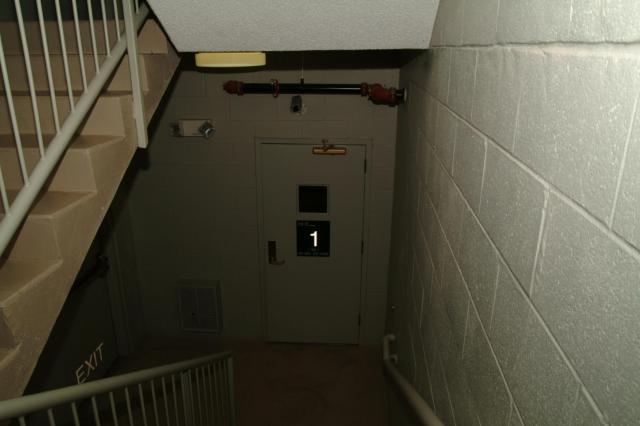
Why do hotels and office buildings lock the stairwells and force you to use the elevator?

First of all, it's very illegal to lock a marked exit: the stairwell is there for fire safety and must be accessible any time the building is occupied - which for a hotel, is pretty much 24-7.

I assume you mean, they're locked from the inside, so you cannot enter a floor from the stairwell.

Image result for exit stairwell

It's a security issue. Some people lock access to upper floors from the stairwell (you can exit the stairwell at the first floor or ground level) to control traffic, to prevent people from transiting from upper floor to upper floor via the stairwells or to prevent people (particularly undesirables) from occupying the stairwell (it's not unheard-of in some places to find a wino or street person, or worse, sleeping or loitering in one).

I've seen a few hotels in locations where I would do that. Going into a stairwell to sneak a smoke in a 'tobacco-free' building is one thing - I do it myself sometimes - but all I need to see is a couple knuckleheads in a stairwell smoking weed, and that's it . . . new door hardware goes on order the next day.

How do celebrities stay in hotels under assumed names?

By not renting the room or registering as a guest. (How to pull that off, and still get a hotel room? You get someone else to do it for you.)

During televangelist Jim Bakker's trial on federal charges in 1989, arising from the previous year's PTL club scandal, he suffered a breakdown and was sent by the presiding judge to a federal medical facility for several days' observation and evaluation. 

Tammy Faye followed along . . . and stayed at a hotel at which I was working, the Days Inn in Durham, North Carolina. 

Image result for tammy faye bakker

This was arranged very much on the fly and, even so, security was tight. It had to be. The trial, and particularly Rev. Bakker's breakdown, was a badly sensationalized news story at the time. There was a lot of 'tabloid' interest in that case as it progressed. Morning disk jockeys were making Jim and Tammy Faye the butt of cruel jokes, and even regular TV news programs had broadcast a tearful, rather unflattering reaction to the events by Tammy Faye. 

Yet, it all went so well because it was elegantly simple. The best way to keep a secret is to not tell anyone.


Why is it difficult to rid a room from the smell of cigarette smoke?

Any scent or odor is made up of microscopic particles of the substance that is the source of the scent or odor. Tobacco smoke floats in the air, and gets absorbed into everything it touches: your clothes (and even the clothing of people around you), the drapes, the bedding, the carpet, even the wallpaper. Once the smoke hits a wall, or a ceiling, or whatever and can no longer escape from the space it's in, it's got to settle somewhere.

Image result for non-smoking room

Because it's mixed with moist, exhaled air, tobacco smoke tends to be kind of damp, to be absorbed into things, to stick like glue as it dries, and to accumulate with added exposure. In a hotel where housekeeping is slack enough to let it get to be a problem, I can stand out in the parking lot and point out the smoking rooms: they'll have that brown film on the glass that contrasts against the white backing of the drapes in the rooms - which itself will be coated with the same film - just like the inside of the car windshield in the vehicle of a driver who likes to smoke in the car . . .

Why are hotels often slow to innovate?

Because we don't have to if we don't want, so why the heck should we? 

Investment is risky. Leave things be, and we can still have enough people come in the door at a rate we kvetch and whine isn't high enough, to keep the property running in the black and get a low return that we kvetch and wine isn't high enough. And people have little to no patience with results that aren't immediately apparent. 

That's the way most people do it, anyway. Asking me why they don't innovate is like asking me, why would someone not eat, or why would someone not breathe? I can only speculate. But there are a lot of natural human flaws that get in the way, so some of this stuff even comes up for me more than I should let it.


So here goes with some speculation, based on my observations and experience over the years: