Showing posts with label Management theory. Show all posts

Monday, July 9, 2018

Seth's Blog : "Hit the red button"

"Hit the red button"

Everyone on your team should have one.

When we hit the button, it instantly alerts the CEO or someone who willingly takes responsibility for what happens next.

And then the question: What are the circumstances where an employee should (must) hit the red button?

Consider:
  • A sexual harassment complaint 
  • A customer leaves over poor service 
  • There's pressure to ship inferior or dangerous products 
  • The wait in the customer service queue passes 8 minutes 
  • Any other combination of bribery, racism, dumping of effluents, breaking promises, cooking books, lying to the public, etc.... 
If you don't have a button, why not?

The red button makes it clear to your team that they should either solve important problems on the spot or let you do so, and that not treating a problem seriously is not an option.

And if you don't treat your project seriously enough to have a button, if there isn't a culture where you want people to either fix these sorts of problems or get them looked at immediately, why not?

We can compromise our way into just about anything. At least do it on purpose.


Image result for red button

Seth's Blog : Whose business are you minding?

Whose business are you minding?


Industries have rules. Rules and benefits.

Hollywood requires agents, casting calls, big budgets and content aimed at a certain part of a certain market. If you follow enough of the rules, the thinking goes, you get a multi-million dollar budget and the red carpet.
Broadway requires a certain length, certain compromises, certain deals. This creates scalpers and hangers on and small audiences filling small theaters. And, if you follow just enough of the rules, you might end up with Hamilton. Perhaps one in 10,000 pull this off.

Publishing requires a fealty to the book and to the bookstore, alliances with the right cultural forces and a willingness to create scarcity. If you're persistent and very, very good, you can get picked by the New Yorker and you get picked by Little, Brown and you end up with The Tipping Point. Perhaps one in 100,000 pull this off.

Outsiders who want in, who want to make their mark in movies or investment banking or in politics often decide that minding the business of their industry is the way to reach their goals. After all, it's the insiders that win the awards and get the benefits that go to people who are by and for their industry.

But what if instead of focusing on the industry, you focused on the change you seek to make? On the audience you seek to serve. On doing your customers' business, not the industry's...

It's not in any of the manuals, but the door is wide open, the path is far wider and you can start today.
      

Image result for standard hotel

Can we open our own restaurant by studying hotel management?

Obviously you can, lots of people do . . . but without specific knowledge, skills and ability in the management of a food and beverage operation, you're adding a great deal of risk to what is already a risky venture. 80 to 90% of independent, non-franchised restaurants fail within the first two years.

I've actually heard human resources people talk as though middle management is middle management — if you can run a hotel, then obviously you can run a restaurant; if you can run a convenience store, then obviously you can run a movie theater; if you can manage a daycare then obviously you can run a hotel — and I've always wondered how such genius evolved on earth.

Image result for hot dog cart in front of hotel

I've managed hotels for years. I've managed motion picture theaters for some 15 years in addition to that, and there isn't that much about running theaters that qualified me to manage a hotel. Even the art and science of supervision is different: with theaters, you use minimum wage teenagers; with hotels, you employ adults who have to make a living on what you pay them, who are more likely to question the legitimacy of any authority you try to assert, and with whom you cannot deal so arbitrarily. Supervising kids truly is ‘kid stuff’ (bad pun) by contrast to supervising adults. Things we associate with “management” — organizing ability, hiring, training, staffing, discipline and supervision; vigilance, marketing ability, troubleshooting and problem solving, recordkeeping, overall responsibility and accountability — are all together just one part of the required skill set; and many of those parts aren’t doable without some specific subject matter expertise. If you don't know what you're trying to manage, there's a very low limit to how well you can manage it.

Monday, August 7, 2017

What are some interview questions for a general manager of a hotel?

So, you want to run one of our hotels?
This is a question that I took my time answering because I wanted to 'finish' it. But I'm never going to 'finish' it. Even if I could give you an exhaustive list, anyone who approached interviewing applicants for hotel manager accountabilities intelligently and responsibly would keep changing it or adding to it.
(I don't want you to have an exhaustive list, anyway -- I don’t like people ‘gaming’ my interviews, and giving up an exhaustive list would be like posting the 'right' answers in advance for those who'd want to access them.)
I'll add more as I have time and opportunity.
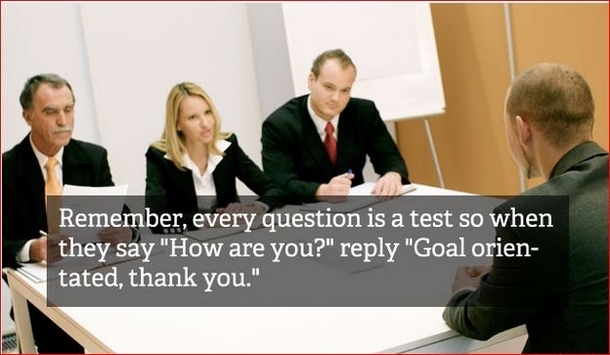
Pic #1 - Job Interview Tips
Frankly, I think the whole model of job seeking, resume-writing, and interviewing that prevails, is a sick game to begin with. Like a parole hearing in a prison it rewards, and even reinforces and encourages, inauthenticity; and it penalizes honest applicants.  The interviewee tells the interviewer whatever he or she wants to hear, the interviewer knows this and corrects (often as not overcorrecting) accordingly, both sides try to look good, very little true communication occurs; and if any subsequent choices or decisions made on the basis of the conversation turn out to be correct or even respectable, it's by not much more than chance. Actual studies have shown that you can make decisions almost as well as most any employment interviewer by simply deciding it on the basis of a coin toss.
But unfortunately, we're stuck with it -- like Sir Winston Churchill said of democracy and its well-known dysfunctions, no one's ever been able to come up with a different way of doing it that works even that well.
That's why I try to come up with questions that are not so easy, for people who want to tell me what I want to hear, hoping to manipulate the outcome in their favor, to anticipate the 'correct' answers to. It’s also why a short class in listening and re-creation, the way the Landmark Introduction Leaders’ Program trains people in doing it, is something that I try to give most people that I have doing any interviewing for anything more than a low-level hourly employee.

Tuesday, April 18, 2017

The terminology

Thanks, Anthony (Timeline Photos - Anthony Melchiorri | Facebook ). This could be the start of something big once we keep adding to it and linking back to it.

Some terms are industry jargon, others are specific to a particular brand or chain.

Contributions are welcome.


'Bucket': A vertical file, with a tabbed divider for each room in the hotel, into which the registration sheet that you signed is stored until you check out. In the days before computers, when this was a much more useful piece of equipment, it was also the repository for your bill (see folio).

Wednesday, February 1, 2017

How do hotel owners shop for management companies?

Generally, the client-owner has a problem (or a want, or a dream, or a desire, in the case of a developer who wants to build a new hotel; but even that's a 'problem': at least that's a problem worth having); and goes to whoever he thinks can offer a solution. He's often not aware that there are even as many choices as there are to pick from.
Sometimes, it's a banker or an attorney or a franchise brand rep who refers him to a management company (usually a much larger, more established one). Sometimes, they actually do go online in search of one.
Image result for hotel management agreement
I know they don't all consult Forbes magazine, but I've gotten several calls as a result of articles I've written that were published on Forbes - every one of which was picked up by Forbes right here on Quora, and none of which contained my phone number. They just read the piece in Forbes, googled Beechmont, and found my badly SEO'd website that I only launched back in the spring (I need to find a way to fix that robots.txt), and a bunch of my answers on Quora (I love it that Google spiders Quora answers individually).
If one goes through my accumulated material on Quora, one can learn a lot about me and how I like to work . . . and then I get a call. As a way to get my foot in the door, I'll take that any day of the week over being one of those guys dressed up in a tailored suit and tie (which I avoid wearing to work: I'm too much of a hands-on guy) and phony smile, posing on a grand staircase in an upscale hotel lobby; like I've seen on a few management company websites. (No one's going to hire me for my looks, anyway. And frankly, that's just the way I like it.)
But that's just how people pick me.

Saturday, January 28, 2017

Is it illegal to check into a hotel under a wrong name?

It's not illegal, but we're not going to let you do it. Every guest must show an ID at check-in. (That's not a law, it's our policy, and one we feel that it would be irresponsible to not have, and to not go by. Our house, our rules. You don't have to show the ID, but if you choose not to, we're not going to rent you a room. Your choice.)

Image result for couple checking into motel

Famous people just have someone else check in for them. As long as that someone else is actually staying in the hotel, we let them (Michael Forrest Jones' answer to How do celebrities stay in hotels under assumed names? ).

About the only law I've seen on the subject shows up in Southern states, the Carolinas in particular. Don't sign in as "Mr. and Mrs." at a hotel or motel in North Carolina unless you are in fact married to the person accompanying you: it's a violation of a statute entitled 'Occupying a Hotel Room For An Immoral Purpose'. 

Turnarounds (Business): How is a declining company turned around?

I've done them before - both hotels and motion picture theatres. 

The first question you must ask is, if this failing business didn't exist, would you build it from scratch and launch it today? If the answer is 'no', it's time to deal with reality.

Image result for lean on me movie

Whether it's a business in itself, or a unit or location of a larger business (e.g., a chain-owned hotel, or theatre - and if you can't run one right, you can't run a chain of them doing it the same way . . .), don't bother unless resources are ample. A turnaround is basically a 'do-over' of a business venture doomed to failure. It wasn't launched - even as successfully as it might have in any better times it might have had - on a shoestring, by someone trying to milk the last five bucks out of a $3.98 investment, and it won't be turned around by such a person or in such a manner. Very few can be turned around without significant commitment of present and future resources.

Which brings us to an accounting of that few that might - and this applies to all of them, whether significant recapitalization is necessary or not:  If it's a unit or location of a larger business (or even if it isn't), you need flexibility as well as resources. I don't want to hear it about 'company policy this', or 'company policy that', or 'this is how we do/have always done things': it's your company policies and the way things have always been done, that caused - or at the very least, permitted - your operation to get into trouble to begin with

As a newly appointed manager at a store with mainly college students as employees (I myself am 22), how do I assert my new authority without the transition being too harsh or uncomfortable for all involved?

Don't worry about your authority. Your only concern is getting the job done. Okay, you have this store to run, you have these (however many) people to help . . .

Image result for staff meeting

Stay focused on objectives, not your 'position'. Everyone can buy into objectives. No one cares, or wants to care, about anyone's position. You can walk on water without getting your feet wet and still have people not wanting to buy into your 'position' . . .

Originally appeared on Quora

Thursday, January 26, 2017

When hiring for your startup, how much does not having a college degree play into your decision?

Zip. For someone who can deliver the goods, the degree (or lack of one) is irrelevant. For someone who can't, it amounts to nothing more than a degree in "you owe me a chance because I went to college".  (Michael Forrest Jones' answer to Do employers take the University of Phoenix seriously when considering an applicant's resume? | Michael Forrest Jones' answer to What is it like to be a high school dropout?   )

Image result for college degree

Oh, you've "proven yourself"?  Maybe you have -- to someone else. My hiring decisions are about my needs, not your pedigree or credentials.

Originally appeared on Quora

What book should I read to learn about hotel management?

Hopefully, more than one book. 

No single person, not even I, knows enough about it to tell you everything you'd want to know. It's like asking what book you'd read to become a good automobile mechanic. Or what book would you read to beat the stock market (I picked up one a few months back about just how impossible it is to do that, or for anyone in government to regulate it without doing more harm than good, for that matter, because while everyone has little bits and pieces of information and understanding of it, no one knows enough about the whole of it to do it successfully: The Myth of the Rational Market: A History of Risk, Reward, and Delusion on Wall Street: Justin Fox: 9780060599034: Amazon.com: Books   ).

And if hotel management is something you want to get in to, you'll want to be the kind of guy who'll add something, make a contribution, of your own if you're going to build something that'll stand out from the general lot of them - otherwise, at best, you can hope to be just another guy running just another Hampton Inn. You'll also want to be the kind of person who'll walk around, see things, watch things, read through printouts of numbers that most other people would consider quite dry and boring, ask questions (and over time learn to ask the right questions), and make best possible use of the answers. Believe it or not, watching Hotel Impossible on The Travel Channel (http://www.travelchannel.com/tv-... ), and learning to make like Anthony Melchiorri, can help here. I'm a fan of the show, and I'm not ashamed even to admit that I learn things from it.

Image result for check in check out jerome vallen

That said . . . let's start with the basics.  Get the latest copy (or the next-to-the-latest: it's a college text and priced accordingly, and I don't like the margins that college bookstores, and publishers and other retailers of college texts, make on required texts . . .) of  Check-In Check-Out: Managing Hotel Operations (8th Edition): Gary K. Vallen, Jerome J. Vallen: 9780132059671: Amazon.com: Books (there's a 9th edition that was released in 2012, vs. 2008, but it's $110, and the only thing of serious importance that's happened since is a mortgage crisis and real estate crash that affected hotels as badly as residential mortgages; but is irrelevant to operations and management, the topics in which you show an interest and in which no major advances have occurred.)  

I am a hotel owner. I sometimes have guests sneaking in more guests who are not registered. Our liability insurance only covers guests, and these extra visitors use our amenities and often leave the place a mess, and are a nightmare when they injure themselves, etc. How do I deal with this?

You don't have my shoulder to cry on about this one.
I've never visited your hotel (I'm assuming here that it's in the USA), but if I did, what I'd expect to find is that you've got bigger problems than guests sneaking in extra people; and that the way you operate, you're bringing it down on your own head.
And if I had your guest list in front of me, I'd also be willing to bet before even looking at it that most of your guests live in or around a single city - the one in which your hotel is located. I suspect based on the information that you provide in your question that your hotel's business is entirely too 'local'-dependent.
Image result for hot pillow motel
And you've let it, or you're letting it, get out of control. Simply put, your hotel's security sucks.
So far, you've gotten off easy with high cost of amenities that non-guests help themselves to, and some property damage. Eventually, you're going to have a serious crime occur there.

Wednesday, January 25, 2017

If a hotel management company is compensated based on sales, wouldn't it be incentivized to increase sales instead of profitability?

It is, and it frequently happens.
Hotel management companies charge a base fee of two to five percent of revenue. And many charge an incentive fee of fifteen percent of any increase in revenue over that of the prior year. The base fee is assured. The incentive fee may or may not amount to much, if there's an improvement in revenue over last year at all. (There are also upgrade fees, and those offer their own opportunities for abuse, but we're not dealing with those as part of this question.) 
So, if I want to ramp up my fees, the fast-and-easy way to do it (if not the best way for the client-owner) is to get as much money coming in the door, as soon as possible, without a lot of thought to how much your costs are eating up almost all of it as fast as it comes in. Offering low rates to certain people just to fill the rooms? Do it. Renting to rowdy local people? Do it. Bringing business into the hotel that costs us as much as they pay us? Do it.
But if our agreement is tied to profitability, such an agreement would have hazards of its own. It would incentivize a lot of bickering between us and the client-owner about what should count as profit and what shouldn't, and how we could have made more profit if we'd done this, or hadn't done that. It would disincentivize reinvestment, or even good maintenance. It would incentivize shortcuts that would have consequences that would come up later. It would incentivize the taking of risks that might have bigger consequences that would sooner or later show up. It would incentivize doing things on the cheap. Your property would lose value over time and sooner or later have bigger problems.

What does it take to run a successful hotel?

I could ask, 'define success'. Are you running a Motel 6 on an I-80 offramp in Podunk, Kansas; or are you going to go all out with mega-luxury, rooms you can rent for $800 to $3000 per night, lots of meeting and banquet space, and a restaurant that people will fly in for; and give the St. Regis [http://www.tripadvisor.com/Hotel...] a run for it? It makes a difference. Usually. For this answer, I'll try to not let it.
Image result for successful hotel
Like my answer to What does it take to start a hotel?, this is one of those open-ended questions that I wouldn't touch with a ten foot pole, but for the fact that someone of the caliber of David S. Rose was doing the asking (which could work into a great leap forward for my company if he should ever decide to stray outside tech ventures and into more real estate, "Main Street" businesses, and bricks and mortar-related stuff, and he likes my answers on the subject); because no answer anyone could give would come close to adequate.