Showing posts with label Property ambience. Show all posts

Tuesday, April 18, 2017

Does your cat meow back to you when you talk to it?

My two cats don’t, but some do.

I’ve had cats that did. And I could introduce you to one that does.

This is Sally. She’s the official mascot at the Brookstown Inn in Winston-Salem, N.C., one of my favorite hotels in the area. I was doing some work for them a year and a half ago, and we’ve ‘spoken’ quite a few times.


The Historic Brookstown Inn - Timeline

Sally is a hotel cat, and the almost perfect hotel cat at that.

(One of the things The Algonquin in New York is famous for — besides the Round Table and the $10,000 martini — is an even more famous hotel cat, Matilda. She gets lots of fan mail — the hotel g.m.’s administrative assistant and ‘chief cat officer’ helps her out with answering it, since she ‘doesn’t have thumbs and can’t hit the space bar’ — she has her own Facebook page, and they have a big birthday party for her every year in the ballroom.)

Thursday, February 16, 2017

What do hotels do to keep their marble or any other stone floor spotless?

With stone? A strong soap and a weekly going over with a fiber scrub brush (in an area where food is not usually present, you might let it go a little longer, but don't abuse the privilege). At a Dairy Queen where I worked as a teenager, Wednesday night was 'scrub night' - we took about an hour and a half after closing and routine cleaning, and the entire terra cotta floor got done. Rinse well (you don't want to be leaving any soap residue in 'natural' cracks and crevices) and dry-mop as well as you can.

Image result for marble flooring maintenance

With polished marble? I'd go a little easier on the soap, maybe use something made to purpose (here's one commonly found brand: http://www.totalvac.com/WT760051...  ), and apply an extra layer of polish as necessary. 

Many polishes nowadays can take quite a beating and last quite a long time: it's shouldn't be like the old days where you should have to strip and re-wax three or four times a year. If you have the care instructions provided you by the supplier of the marble, you might want to take a look at those - I file away any paperwork I get on any furnishings and equipment I buy, but any commercial flooring or janitorial supply dealer should be able to hep you with what you need.

You can outsource it if you want, but remember . . . you pay your maintenance guy eight to fourteen bucks an hour and you can buy all the materials you need at Home Depot and even rent a floor buffer: contractors have a much higher per-hour rate for labor. Do the math . . .

Originally appeared on Quora

Do hotels give out the most undesirable rooms at check-in by default? If so, why?

It happens but I wouldn't say it's something that happens altogether 'by default'.  See Michael Forrest Jones's answer to How do hotels assign rooms.

First of all, undesirable rooms are tricky to sell, at least to other than undesirable guests. We want the room to be fresh, clean, comfortable, everything in it in good condition and working; because we want you to like us, and like our hotel, and we want you come back (and if for no better reason than we don't like to hear you complain).  I take it that you mean undesirable as 'less to be desired than other rooms of generally equal size, furnishings and amenities' (say, because of not much of a view, or at the end of a long hallway, or it's because it's too close to an elevator or a vending area and you have to put up with the noise from that), a few of which will be present in any hotel.  

Image result for bad motel rooms

Also, keep in mind that in a well-maintained property, there won't be too much variation in the quality of the rooms - if any at all is noticeable. Some will have more space or amenities and will sell at a higher price. Some will be due for remodeling, if the hotel is large enough that remodeling is done in stages (e.g., they do one floor every couple of years, so that over a ten-year period, the rooms on all five floors get done and it's time to repeat the cycle) and where such a state of affairs is present, what I might do is price those rooms a little lower. But even then, the variation in quality isn't going to be that much: you shouldn't even notice it. As a practical matter, it can't be. Too many guests that come in are not shy at all about wanting the best room in the house at a discount off what the guy in the cheapest room is paying.

Monday, February 13, 2017

Which is better, to book the cheapest room in a 5-star hotel, or the best suite in a 3-star hotel?

It depends. Would you like to stay in a 5-star a 3-star hotel?
Most of my experience is in mid-market hotels. Even in those we get the occasional bargain hunter you see lots more of at an economy tier property. Hotel room rates can be negotiable, although not nearly as much as some people seem to have the impression. But a lot of people do walk around with that impression, so we end up dealing with quite a few people who want the best room in the house at a 10% discount off what the guy in the cheapest room is paying.
(I let it drive me a little more nuts than I should, but it's a personal pet peeve of mine. When I’m having a bad day, I get onto YouTube and bring up that video of Priceline Negotiator heading off a cliff in that bus, and it makes me feel better. Nonetheless, it does happen.)

Image result for five star hotel
So, it is kind of awkward for to have too many 'levels' of quality, amenities, service level, or price within a single hotel, or that much of a spread between them. I might set aside a specific room or suite, that's a little extra nice or that has a nicer view, for someone special if I know ahead of time that they're coming, and put a few extra amenities, maybe a freebie or two, in there. But generally, what you call the “best suite in (the) hotel” isn't that much better than the average suites of the same type. It may be a suite instead of a room, and it may rent for a little more, but neither the price nor the quality will vary by much.

Thursday, February 2, 2017

How do good hotels always feel so clean and fresh?

Housekeeping. You may think your own home is nice and clean, but even if you're an obsessive-compulsive neat freak, hotels play it at an entirely different level. We have to. 
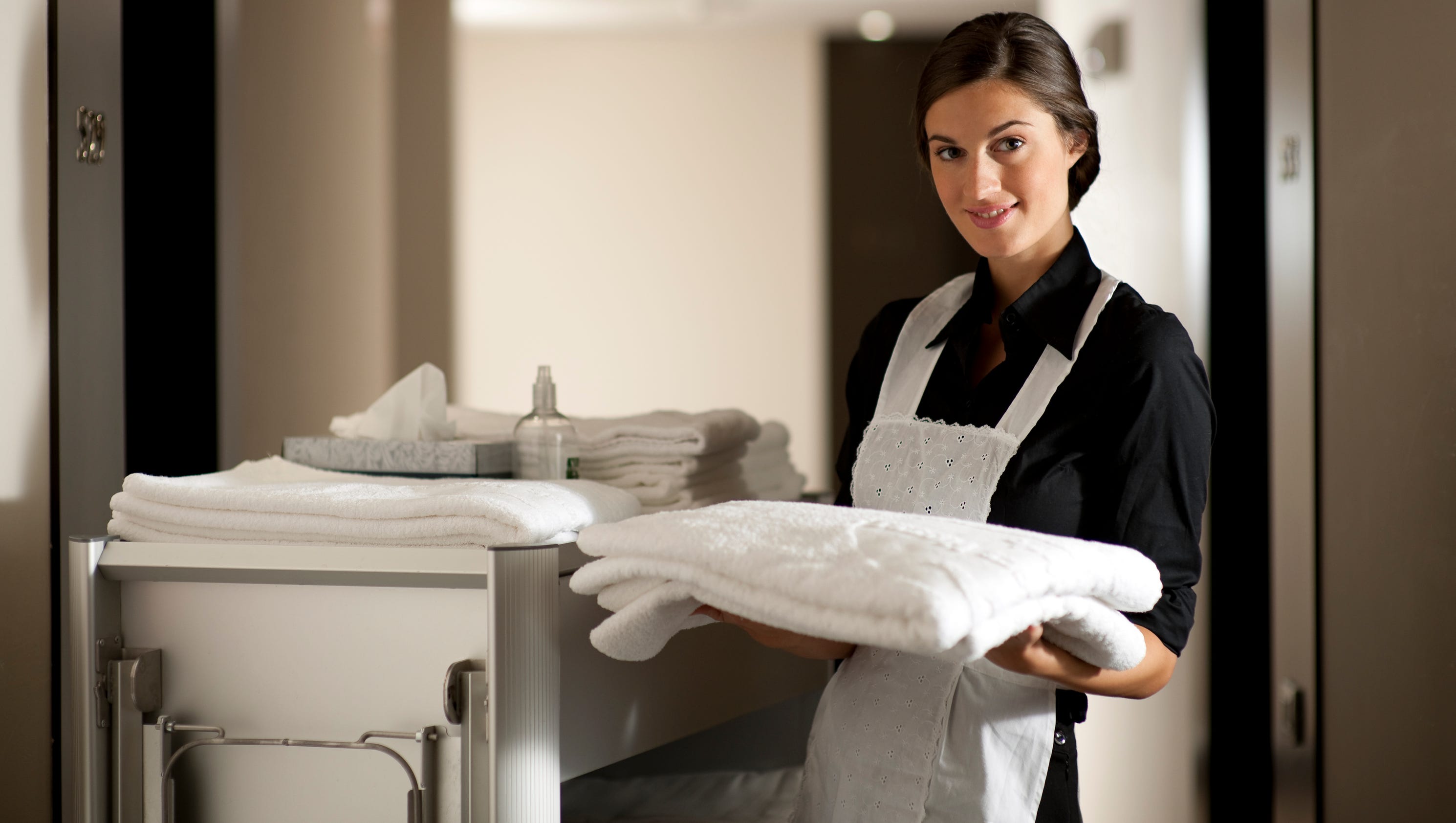
Image result for hotel maid
For example, do you change and launder your sheets every day? No? But you put fresh sheets on the bed if you're expecting house guests for a few days, on any bed intended for their use, right?  And you supply them with fresh towels, not one you used yourself once already. And even then - well, when was the last time you steamed the carpet in your guestroom, or turned the mattress over?
All hotels deal with are house guests.

Wednesday, February 1, 2017

How bad are these hotel housekeeping lapses?

How bad, as in 'how dangerous', or 'how extremely gross'?  Not very. Usually, when they occur, they're pretty obvious, like the ones you mentioned. Usually, someone, often a guest, will spot something with the potential for extreme grossness before it gets too gross. Even the less obvious ones - dust across the top of a picture frames, film in the tub, grunge around the base of the toilet, something under a bed (beds should be on box bases, not angle-iron frames; but in some hotels, some still aren't) - are pretty obvious if someone just looks.

Image result for anthony melchiorri housekeeper

As far as dangerous or extremely gross goes, the worst I've seen - at separate incidents, in separate hotels of varying quality - were sharp objects left laying around: once the blade of a carpet knife left in the floor of a room where the carpetlayers weren't doing a very good job of picking up behind themselves (the hotel was being remodeled on the fly) resulting in injury to a guest; another time a hypodermic syringe left in the drawer of a nightstand (fortunately no injury beyond a disgusted guest who demanded a refund right away, although I'm aware of a situation that did occur at a Motel 6 in Virginia Beach where a small child had an unpleasant encounter with a previous guest's syringe while crawling around in the floor, and had to be hospitalized).


Hotels: How do people choose a hotel?

It's very much an individual decision. There are as many possible answers to this question as there are hotel guests. 

Actually there are more possible answers than there are individuals. Every individual has his priorities, but for each person, one or more secondary factors will be taken into account as well -- many of which will still be significant enough to make a difference in whether or not he wants the room at a particular hotel at all, and any of the others sufficient to prompt him to choose one hotel over another.


If I knew them all, I could retire comfortably in just a few years. (And if I knew, out of fifty-odd numbers, which six will win next week's Powerball jackpot, I could retire even more quickly.)  But I can't. I'm not a mind reader.  Besides, there's seven billion people on the planet, times . . . how many features, and services, and amenities are on your list of 'must have' items when you check into a hotel (as you'll see, they don't have to be big things . . .), times . . . how many possible combinations after you take into account all the other possible things in or about a hotel that you could care less about?  Do the math. It's a big number.

Several factors do turn up over and again, however:


Saturday, January 28, 2017

Are hotel reviews more relevant in the buying process than the categorization by hotel stars?

Think of it as the difference between the Emmys and the People's Choice Awards.

The 'stars' are ratings based upon the hotel's service and amenity level - you have to have a free continental breakfast to get this many stars, you have to have a restaurant and lounge to get that many stars, you have to have room service to get one more. Michelin, AAA, and anyone else who awards 'stars' each has their own criteria re how many 'stars' to award for which set of amenities: they're their stars to give, and they make the rules and give them out as they please (Hotel rating ). If I want to develop a new 'four-star hotel', I'm going to make sure I plan ahead for my new hotel to have everything on those lists of requirements for a four-star rating.

The reviews by guests on TripAdvisor are submitted by guests (hopefully real guests, not sales staff - Michael Forrest Jones' answer to What's the best site for getting hotel reviews? ), and based on their experience staying at the hotel.

Image result for red roof inn

One surprising example of divergence that we noted in developing our new economy brand (Calico Inns - Beechmont Hotels Corporation ): Red Roof Inn is an existing 'economy' brand. The last one at which I stayed, in Bethlehem, Pa., was a 'two-star' hotel - but it had a TripAdvisor bubble score of 4.0 out of 5.0. (Okay, I helped - Every town needs a 'good, $65.00 motel' . . . - but it still had four bubbles before I posted my own review. If anything, I penalized them: I gave them fives in every relevant category, but took one away on the final score for going "100% non-smoking" and not having a smoking room for me on my last trip.) 

After checking out of a good hotel, what services is it reasonable to expect to use for the remainder of that day? (I checked out of the Park Hyatt today at noon, left my bags and when I retuned to collect them I sat in a reception lounge reading for a bit and I charged my phone. I was told that as I was no longer a guest I shouldn't stay long! Where would be a good place to draw the line as a recent guest and what you can and can't do.)

I can't give you a good answer (at least not in terms of present-day applicability) to that question because frankly, most hotels do not have a policy on that, nor have they ever considered one.  

Someone on the hotel staff might okay it, as a personal accommodation in the spirit of hospitality (which most hotels encourage among their staff - and I will concede based on what you tell me that the staff at the Park Hyatt that you describe was being a bit harsh). But - as you yourself noticed -  that leaves you at the mercy (or whim) of the hotel staff; which can vary not only from hotel to hotel, but between individual managers and staff members within the same hotel.  

Image result for hotel business center

A hotel needs to have a policy in place for it, and frankly, most don't. (Unapologetic spam piece: now that I've seen your question, we will.) 

Thursday, January 26, 2017

What is my best bet to find nice hotel rooms, as opposed to "simply average" hotel rooms?

Check TripAdvisor. People on TripAdvisor are generally pretty candid about what they think of a hotel and its rooms. And while in the past, it has been criticized for giving inadequate protections to hotels from malicious reviews (by employees of competitors, or people who never stayed at a certain hotel), TripAdvisor now has enough of a critical mass of users, and generally enough safeguards in place against fraud and blackmail, that nowadays, it can be counted upon for a pretty fair description.

Image result for hotel room upgrade

I hope you don't find this answer disappointing, that you weren't counting on, say, some inside information that only people in the industry have access to to make such determinations. 

But really - we use TripAdvisor, too (often to 'spy' on each other, see what our competitors have that we need to get, what they are doing that we need to be doing) . . . It also tells us, out of all the stuff we try, what guests actually respond to.

I am a hotel owner. I sometimes have guests sneaking in more guests who are not registered. Our liability insurance only covers guests, and these extra visitors use our amenities and often leave the place a mess, and are a nightmare when they injure themselves, etc. How do I deal with this?

You don't have my shoulder to cry on about this one.
I've never visited your hotel (I'm assuming here that it's in the USA), but if I did, what I'd expect to find is that you've got bigger problems than guests sneaking in extra people; and that the way you operate, you're bringing it down on your own head.
And if I had your guest list in front of me, I'd also be willing to bet before even looking at it that most of your guests live in or around a single city - the one in which your hotel is located. I suspect based on the information that you provide in your question that your hotel's business is entirely too 'local'-dependent.
Image result for hot pillow motel
And you've let it, or you're letting it, get out of control. Simply put, your hotel's security sucks.
So far, you've gotten off easy with high cost of amenities that non-guests help themselves to, and some property damage. Eventually, you're going to have a serious crime occur there.

Wednesday, January 25, 2017

If I work the front desk at a hotel and someone has been told not to trespass, can I remove them with reasonable force? (This is in Oklahoma, by the way.).

Legally, you probably can, but it's not a good idea. I'd call the cops and let them handle it. It's a nuisance call, but many cops would rather handle it than respond to a larger disturbance, clean up after a fight, or bring an ambulance along for an injury.

Image result for no trespassing signs funny

If you use force at all (or even put your hands on the trespasser) you risk provoking an altercation, or give him the 'ammo' he needs for an accusation against you of assault.  The police can get it done much of the time without using force, and any force they do use will not nearly as likely be second-guessed.

Originally appeared on Quora

What does it take to run a successful hotel?

I could ask, 'define success'. Are you running a Motel 6 on an I-80 offramp in Podunk, Kansas; or are you going to go all out with mega-luxury, rooms you can rent for $800 to $3000 per night, lots of meeting and banquet space, and a restaurant that people will fly in for; and give the St. Regis [http://www.tripadvisor.com/Hotel...] a run for it? It makes a difference. Usually. For this answer, I'll try to not let it.
Image result for successful hotel
Like my answer to What does it take to start a hotel?, this is one of those open-ended questions that I wouldn't touch with a ten foot pole, but for the fact that someone of the caliber of David S. Rose was doing the asking (which could work into a great leap forward for my company if he should ever decide to stray outside tech ventures and into more real estate, "Main Street" businesses, and bricks and mortar-related stuff, and he likes my answers on the subject); because no answer anyone could give would come close to adequate.